Why Not Shake Your Career Up a Little - Flying Freighters.
I think it’s fair to say that most pilots yearning for the airlines think of the path that takes them down towards the self loading cargo side of things - you know - flights with passengers - but many large airlines have dedicated freight aircraft - and some courier companies have their own aircraft fleet - think DHL for example.
Our old mate, Jeremy Burfoot, is one of our article contributors and is also one of our mentors. He has had a remarkable aviation journey and here, he talks about the time he took a three year sabbatical from Qantas and flew B747 freighters for JAL. To add to the adventure, he was based in Anchorage, Alaska, so he had all the fun of polar routes and logistical challenges of snow and ice operations.

Would you trust this man to fly you where you want to go? Jeremy Burfoot, ladies and gentlemen.
Flying Freighters from Anchorage.
Sometime in October 1991, a bunch of pilots from various countries in the world descended on Tokyo to start the training course with JAL. The JAL course was due to take seven months, and we all thought that was a bit excessive. But it was their train set, and we were getting paid, so we pretty much just went with the flow.
I guess you are wondering how it could take seven months for a course to end up flying the same aircraft that I was already rated on? Well, the whole thing was controlled by the Japan Civil Aviation Authority, JCAB, and they were a powerful law unto themselves. JAL seemed to be scared of them.
The JCAB put all sorts of weird requirements on us. We had to learn Japanese aviation law, which was logical, but then there was the radio exam where they still asked questions on valve radios and other things from WW2. Even worse, we had to learn the answers in lousy English. If we wrote our own responses, the marker wouldn’t understand them. On the day of the radio exam, everybody was tense at the training centre because the JCAB was coming. We suspected that some JAL people would meet the JCAB downstairs, do a bit of bowing and scraping and then carry him up to the testing area on a litter.
The exam itself wasn’t too hard after two weeks of memorising rubbish, but then at the end of the radio exam, we had to do an aural morse code test with the examiner. This involved doing a certain number of letters in a three- minute period. But there were rules. You couldn’t get it done too quickly, either. If you did, you would fail. So, I roared through all the letters except four in two minutes, then slowed right up, saying one every 15 seconds. After the second 15 second gap, the JCAB guy was looking at me, waiting for me to say another one, and then he just said, “Ok desu. You pass.”
I was all fired up for the simulator phase of the training. The first thing I noticed was that they had their own way of doing things. This may have been because Qantas had their own way of doing things, and JAL followed full Boeing procedures. The other thing was the use of bad English in the procedures. That made it more challenging too, but I had studied all the calls reasonably well during my time off and had memorised most of them. About ten simulators later, we were given and passed our final simulator check ride. Now we were going to be shipped to Moses Lake in Washington State, USA, for aircraft handling training.
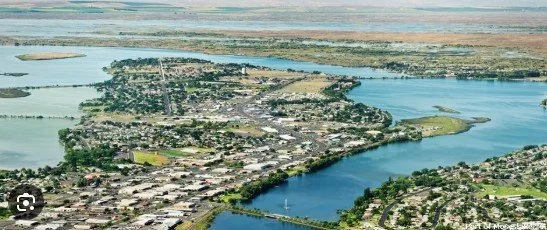
Moses Lake, Washington State - it’s very…. flat.
Moses lake is uninspiring, and being mid-February 1992, it was cold and dreary. They stuck us in some tragic motel on the edge of town. It was pretty depressing, really, but the flying made up for it. JAL had a crew room at the airport and an operations centre for briefings etc., so the operational setup was good.
The airport itself used to be a military facility, and it had a runway 4,110m or 13,500ft long. It was well suited, too, for the purpose of base training for JAL. We met our instructor, Captain Honzawa, who seemed like a good dude. He gave us the complete briefing on a whiteboard. This was funny because when he described the circuit we’d be flying, he drew all sorts of odd things on it, like the Target store, which we could use to line up on. But when he drew the downwind line, we expected a straight line, but he put a hernia-like bubble extension out to the right. Then he drew a house where the line should have been. “This is Mr Bator’s house,” said Honzawa. Then he paused and sucked a huge breath through his teeth. “Most severe. You must not fly over Mr Bator’s house,” he said. Mr Bator had shot at a 747 flying low level over his house in the past, and since then, the circuit had been crooked. Someone should have told Bator the war was over. That would have simplified things.
For the first four days, we flew with Honzawa San. We’d climb up to about 10,000ft, and then we’d practise steep turns at 45 degrees angle of bank. I can tell you that it’s easier in the aircraft than in the simulator. With a bit of concentration, you can actually go from left bank 45 degrees through level to right bank 45 degrees without climbing or descending. After steep turns, we’d do full stalls and stall recovery, which in a big aircraft like that, is quite something.
On the third day, we did all this in moderate to severe icing conditions in the cloud. I was not happy with that at all, but we survived. After upper air work, we’d head back and fly an offset NDB approach, then hit the circuit for standard and 500ft circuits. These circuits were all good from a safety aspect except that there were nearly always two 747s in the circuit. Quite often, we’d be making an approach to land with the other bird doing the same from the opposite direction. One 747 would always have to peel off at the last moment. It crossed my mind that the risk of doing this was right up there with doing upper air work in icing conditions.
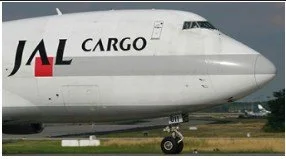
Day five was our check day, with Honzawa San in the co-pilot seat and a JCAB checker watching from behind us. The morning of the check, we got picked up early at sunrise. We arrived at the centre and were marched in to stand at attention in front of the JCAB examiner. We had figured out that the deal with the Japanese was not to keep getting all the questions right. You needed to get two or three right and then get one wrong. Otherwise, they’d keep asking until you got one wrong. Being clever was not clever.
It all fell in a heap from the beginning because the JCAB bloke’s English was so bad that we had no idea what he was asking. As a result, we got the first three questions wrong. I can still remember one of the questions. He asked, “How do the lights change?” What would you answer? We had no idea, so I said, “With a switch.” Later in the debrief, he showed us a coloured picture of the runway lights changing from green to orange then red as the end of the runway came up.
After the supposed failure of the oral exam, we were marched out to the aircraft and launched to run through our routine that we’d been practising for the last few days. One of the standard things on short final for landing was for the engineer to call 50ft and 30ft as you entered the flare for the landing. In my previous landings, I was having a great patch of super smooth landings, then on the final one, someone told the engineer not to call it. Luckily, I picked it up from my peripheral vision and flared a little late but slightly quicker and did a super smooth landing again, thinking “I showed you!”
A little while later, we were in the office again, standing at attention in front of JCAB San. He paused for a minute and then said, “You pass.”
From Moses Lake, we were transported to Anchorage for the first time. We had a few days courtesy of JAL at the Hilton in the city to check the place out. It was cold but super interesting and exciting to be there. In the foyer of the Hilton were two stuffed bears on their hind legs, both about nine feet tall (Melissa here... having unintentionally come within 20m of an Alaskan Coastal Brown Bear whilst trekking alone in a supposed bear free area of the Kenai Peninsular, I can attest that they take an acute interest in solitary humans - it stalked me for nearly 20 minutes until I reached safety! 😬 They are definitely big buggers!).
We managed to get a good look around Anchorage and were generally agreed that we would enjoy living there.
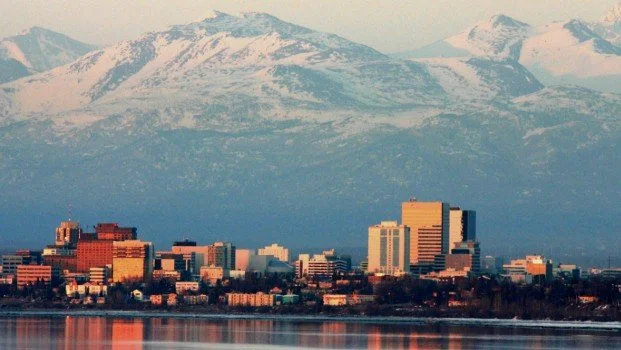
Anchorage - a very livable city
After a good break in Anchorage, it was back to Tokyo to do line training on the aircraft. Before line training was allowed, we needed to do emergency procedures training at the JAL training centre. This involved jumping down slides and climbing in and out of rafts with a heap of Japanese crew as well. It was quite a good day, and the facilities were excellent.
By the end of May 1992, I was fully checked out and ready to go, but this was only the start of it, as every new place you had to fly to, you required a check ride into it with a check Captain. So, for a while, it felt like you were always under the microscope. The whole training process was like a long, drawn-out colonoscopy, where you lost your pride and indeed some of your confidence. I felt that they were hiring us for our experience and then trying to wipe it from our brains and reprogram us. It was an unusual feeling. Others had worse experiences than me. Some had to redo things and ended up being on course for up to 10 months. One German flight engineer trainee, who was a really nice guy, was being ridden so hard by the Japanese checker on his final check that he cracked and said, “If you stick a broom up my arse, I’ll sweep the cockpit as well.” That cost him an extra two months of training.
And so, it was off to Anchorage at the end of May to be based there. Anchorage is Alaska’s most populous city, and at 291,000 residents in 2020, it contains nearly 40% of the state’s population. Anchorage is in South-central Alaska at the terminus of the Cook Inlet, on a peninsular formed by the Knik Arm to the North and the Turnagain Arm to the south.
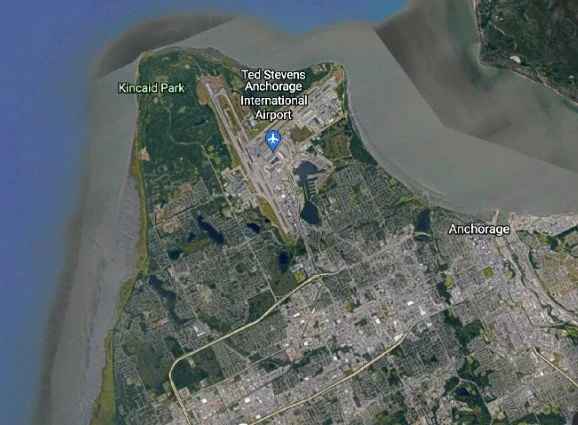
John and I biked from the city to the airport and managed to watch freighter after freighter lined up coming into land. The airport is phenomenally busy with cargo flights.
Due to its location, almost equidistant from New York City, Tokyo and Frankfurt, Germany (via the polar route), Anchorage lies within 10 hours by air of nearly 90% of the industrialised world. For this reason, Anchorage International Airport is a common refuelling stop for international cargo flights. That is why we were to be based there. JAL operated most of their freighters through Anchorage to the USA destinations and across the pole to Frankfurt, London and Paris.
When I first considered Anchorage, I had a general concept in my mind of a frozen wasteland, but nothing could be further from the truth. It got a fair bit of snow in the winter, and temperatures could drop, on occasion, to minus 30c, but generally, it wasn’t too bad. When people turned up at parties, they’d stick their beer outside on the deck to stay cold. And the city was well set up for the cold. Shopping centre car parks were heated, as were garages. Houses all had central heating and open fires. The city had cross country ski trails all over it that were lit at night and groomed daily.
An hour away was the Alyeska ski field, which was quite incredible, with a 2,500ft vertical rise from sea level and the world’s longest double black diamond run. We would drive down, park 50m from the first chairlift and have a big day of skiing.
At 61 degrees north, the sun didn’t come up for long in the middle of winter, but, again, it wasn’t a big deal. We got so used to seeing the northern lights that we got bored with it. The only real inconveniences were shovelling snow off the driveway and changing the car tyres from studded to normal and back every six months.
In the summer, it was completely different, with the sun going down just below the horizon for a couple of hours each night. It never got completely dark, so you could be sitting on your balcony at 2am looking at the view. When the king salmon were running up the Ship Creek, 100 metres north of the CBD, you could go down there at 2 am and watch the anglers standing in the creek fishing. Temperatures would stay in the low 20s 24/7, and T-shirts were the order of the day. Mountain biking was big in the summer, as the cross-country ski trails became riding trails.
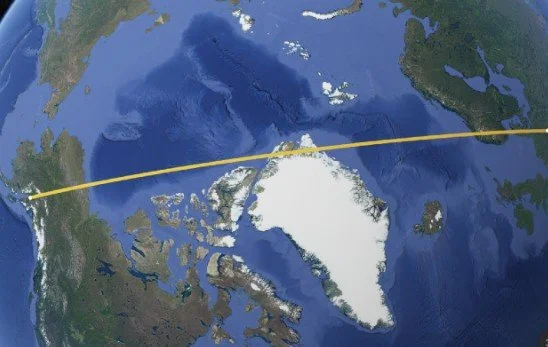
Over the Pole from Anchorage to Frankfurt
In the first month in Anchorage, I lashed out and bought the latest Cannondale mountain bike, which had the first viable full suspension, at a time when suspension was almost unheard of. It also had clipless pedals, which was a first for me, that took some getting used to. On my second ride, I got caught out with my feet clipped in, in the middle of a snow-fed creek, and fell over. That has a way of focusing you on becoming better.
One of the cool things about Anchorage were the number of moose all year round that would appear in backyards and all over the place. We had to be particularly careful with children and while riding in the bush as they could kill you if they got on top of you. They were also a hazard on the roads. Bears were known to be in the area too, so riding in the bush was slightly risky, although I never saw one close to town.
The flying had proven to be interesting, which was a bonus. All of it was on freighters. There are some significant advantages to freighters. Firstly, there are no passengers to deal with and hence no actual schedule. When you are ready to go, you go.
Our flights were crewed by two pilots and an engineer, usually all foreign. It was all the same guys for the first few months because we were some of the first to arrive at the basing.
Sometimes our flights over the pole would take nearly 12 hours, so after a while, it was considered a fair thing for each crew member to take a break in the bunk for a while, leaving two people in charge. If it was the engineer’s time off, we’d time it for when there were no fuel panel configuration changes. It was better for everyone to get a bit of rest than to arrive in Europe in the middle of winter with an exhausted crew. Another reason this was deemed acceptable, was that the bunk was within shouting distance of the cockpit.
A disadvantage of freighters was that there was no flight attendant to bring coffee and cook meals. We had to do this ourselves. Whenever we left Anchorage, there would be three crew meals loaded and a big tray of sandwiches, plus a high-quality packet of assorted chocolate biscuits to fatten us up.
On one occasion, a legend was made over those biscuits. To fill you in on some necessary detail, many of the Americans on the basing hated each other because they had been involved either on the receiving end or the dishing out end, of ‘scabbing’ events when airlines went under and were shut down. Some had taken jobs at the expense of others, and in the pilot world, this is never forgotten.
So, on this occasion, we took off, and my first officer was the scab, and the engineer had been the victim as he’d lost his pilot job. The first officer went back to get coffee and saw that the biscuits hadn’t been opened. He stole them and hid them in his navigation bag. A short while later, the engineer went back and couldn’t find the biscuits. Knowing what the first officer was like, he checked in the guy’s nav bag. And there were the biscuits. He removed them and took the twenty or so sandwiches left from the sandwich tray and jammed them into the first officer’s nav bag. Job done. Taking someone’s job is one thing but stealing the biscuits was a whole new level of bastardry.
Most of our initial flying was either down to Tokyo and back or over the pole to Europe. The flights over the pole were always fascinating. First, we’d take off and head towards the north with the towering Mt McKinley (20,310ft) just to our left on the climb out. Then we’d head past Fairbanks and further north. There were thousands of lakes to look at in the summer, but in the winter, mainly snow and ice. In the summer, it would be daylight all the way, with the sun rotating around the horizon at pretty much the same angle of elevation. In the winter, we’d be lucky if we saw some light over the horizon from any direction.
As we headed north, we would cross the north coast of Alaska and then be over the iced ocean. Then we’d start thinking about grid navigation. The aircraft’s INS navigation was capable of navigating over the pole. But because of the *magnetic north pole being close but off track, the magnetic headings and true headings were rapidly changing relative to the stable grid heading. If the INS were to fail, then navigation would be extremely difficult without the grid. This is too complex to explain here, but it does work.
Another problem with this setup is that if you have lost the INSs and are navigating in grid, the VOR needles would not point to the position of the VOR station.
* Earth’s geographic North Pole and the magnetic North Pole were first recognised as two different places in 1831. Until the early 1990s, the magnetic North Pole was known to lie some 1,000 miles south of true north, in Canada. However, the location of magnetic north is not fixed. Magnetic north was drifting at a rate of up to about 9 miles (15 km) a year. Since the 1990s, however, the drift of Earth’s magnetic north pole has turned into ‘more of a sprint,’ scientists say. Its present speed is about 30 to nearly 40 miles a year (50-60 km a year) toward Siberia.
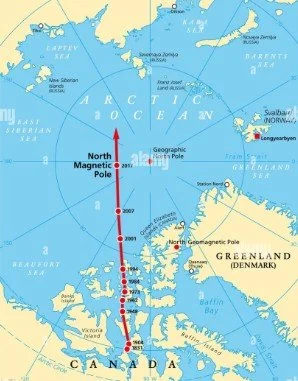
The Magnetic North Pole. It was quite content cooling it’s heels in the North West Passage but now it’s hoofing it’s way towards Russia - is it defecting? What does it know that we don’t? 🤔
INS systems have come a long way since I first used a single system on the RNZAF P3Bs. They were an early system based on a platform with accelerometers and gyroscopes and could easily drift 8nm per hour. We navigators used to work out an error vector for the INS that we would update from good fixes. It was a known joke to tell the crew that although we were heading for Hawaii, it seemed the INS preferred Tahiti and was heading that way now. The technology of INS navigation has improved, but the concept is the same. The outputs from accelerometers and gyros would be integrated using integral calculus to give speed in any direction, which in turn would be integrated to provide distance moved, which logically allows a position and altitude update.
By the time I joined Qantas, we had updated INS versions, and there were three of them comparing their positions with each other. We were able to ‘drag’ the errors back in by updating them from DME range circles. Later updates removed the need for a platform and removed moving parts which got rid of friction errors. How they did this was, for the accelerometers, by using electrical current to stop movement, hence the current was equivalent to the acceleration, and for the gyros by using laser gyros instead of spinning gyroscopes. Unfortunately, laser gyros are still subject to minuscule errors from ‘injection locking’. The fix for this is ‘forced dithering’. Feel free to do your own research, but every time I see someone dithering now, I think to blame ‘injection locking’. Suffice to say, IRS/INS systems these days are super accurate and reliable, and, backed up with triple GPS, it’s hard to get lost.
Anyway, I’m sure some of you have glazed over and are sucking your thumb now, and I apologise for that. Now back to the story…
So, we’d set up for grid and continue heading north, watching the magnetic compass track around us to the right. Most times, we’d not go right over the North Pole, but sometimes we would. That was interesting. Before the pole, you’d be heading north on your navigation display. Then as you approached the pole at 90 degrees north, the system would make you cut the corner by half a mile to reduce confusion in the ‘gubbins’. The INS based true heading would rotate, in jerky movements, 180 degrees in about 5 seconds until you were heading south. In that time, you would have crossed 180 degrees of longitude as well. Most times, warning lights would flash on for a few seconds as well.
With the arrival of autumn in Anchorage, the look of the place changed rapidly, and the colours were unbelievable. It was time to get out and make the most of the summer sports before the first snow. On the 21st of August 1992, I was out mountain bike riding by myself when I noticed a huge black cloud coming over the top of Anchorage from the west. This looks weird, I thought. I was still quite away from home, so I turned back and started heading that way. Within 10 minutes, it was raining grey grit and had become as dark as a late twilight. By the time I got home, I had grit in every crack and crevice and in my eyes and ears. I was still picking it out of places a week later.
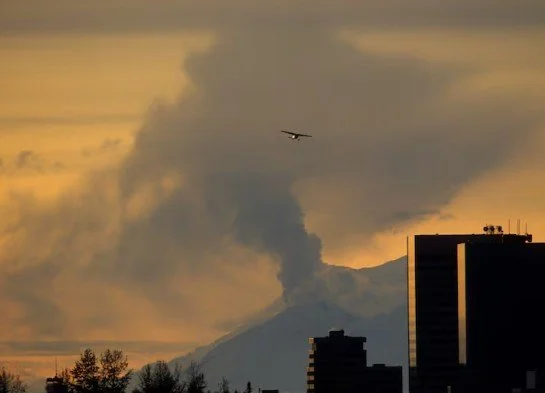
Mt Spurr eruption as seen from Anchorage - what was that pilot thinking!!
It turned out that this was caused by the eruption of Mt Spurr, 130km to the west of Anchorage. Ultimately the eruption reached 13.5km high and stretched 3,500km to the east and southeast. By the time it had finished, it had left a ½ inch layer of fine grey silt over everything, which would be great for the gardens but highly abrasive for everything else. As a result, Anchorage airport was closed for at least a week.
Volcanic ash can be hazardous for aircraft. It can be abrasive for surfaces, including glass and windscreens. It can infiltrate fuel tanks and contaminate the fuel, block sensor tubes, and damage engines, causing them to fail. It’s worth avoiding.
Perhaps the most famous incidence of this was British Airways Flight 9 in 1982 near Jakarta (All Four Engines Have Failed – by Betty Tootell, published 1985 – a brilliant read). They lost all four engines and had no real idea what had caused it. The crew were able to get three engines restarted during the glide. It was a supreme and commendable effort to save the aircraft. Since that event, and even today, crews have been trained in the simulator to handle volcanic ash encounters. It is never easy, even having read all about it and knowing what is coming. This reinforces how well the British Airways crew did.
When the first flights started operating through Alaska again, we had to be driven to Fairbanks to take out the flights from there.
After a while, things got back to normal, and in early November, the Beaujolais Nouveaux stupidity started. Beaujolais Nouveaux is a red wine made from Gamay grapes, produced in the Beaujolais region of France. It is fermented for just a few weeks before being released for sale on the third Thursday of November. It’s also famous for races by distributors to get the first bottles to different markets around the globe. Because the Japanese bought into this weird tradition, it was considered very cool to spend a shitload of money to drink rubbish red on a specific day of the year. So, every year leading up to that day, we’d fly freighter loads of Beaujolais from Paris to Japan via Anchorage. If you do the math, at 110 tonnes of freight and 1 kilo a bottle, that’s 110,000 bottles per flight. Unfortunately, that’s also 110,000 nasty hangovers.
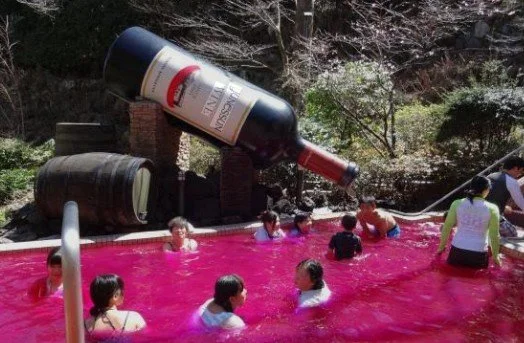
Jeez! It’s a real thing in Japan - they even bath in it. It’s released in Japan annually on the third Thursday of November at 00:01 AM, often making it the first country to taste the new vintage. Oooh kaaay….
And so it was that in the middle of November, I was scheduled to fly to Paris, to pick up a load of this plonk. But it also turned out that each new captain had to do a ‘Cat 2 low visibility’ check out before being cleared to fly to Cat 2 without supervision. We were joined by a Japanese check captain, who would do this check on me. In those days, we were automatically cleared to fly down to a cloud base of 200ft and visibility of 600m. But once we were checked to Cat 2, we could then fly down to 100ft and 400m visibility using auto-land. The qualification would mean less likelihood of a diversion in crap winter weather.
We launched for Paris with a pretty average forecast, but as we went over the pole, the weather in Europe got worse. Paris was right on Cat 2 minima, as were most main centres like Frankfurt. The only place that was any good was Geneva, which had a cloud base of 400ft. This made it legally ok as an alternate destination. With about two hours to go, the Japanese checker emerged from the bunk to check on progress. I briefed him about the weather, and he thought about it and said, “But I’m not qualified to fly to Geneva.”
You’ll remember JAL captains needed to be checked into each destination, and most were limited to only a few destinations so that they got really comfortable with them. Then he said, “I am pilot in command, so I say we divert to Frankfurt.” It would have been illegal and stupid for us to do that, given the weather in Frankfurt. The legalities of the navigation laws and plain commonsense far outrank the silly local rules that some airlines have. When the checker went back to the bunk, I said to my Co, “If we have to divert from Paris, we are going to Geneva, even if you have to take him down the back and tie him up.” He agreed wholeheartedly.
Just before the descent into Paris, nothing had changed, and the Japanese checker jumped into the first officer seat for the arrival with the Co on guard at the back. I gave my arrival briefing, and in it, I briefed for Cat 2 Auto-land. Cat 2 is not allowed without auto-land, as the auto-land system is not subject to the human errors that are common in low visibility conditions. Humans are better off monitoring the autopilot doing its job. So, I briefed for Cat 2 auto-land, and the JAL checker said, “But you aren’t qualified to do that yet. You will do Cat 2 manual landing.” At this point, I looked back at the Co, who had a wry smile on his face and then I said, “I’m not prepared to do that. So it’s either auto-land, or you can fly the approach.” He sucked through his teeth for a bit and then said, “Ok, you do auto-land.”
And I did, and the weather was as crappy as they had forecast. At 100ft, I could just see the runway lead-in lights.
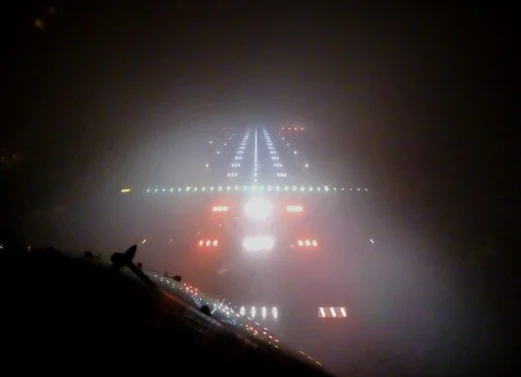
FO’s view of a 100ft auto- land in fog.
In the end, the autopilot did a great job. We touched down, and I pulled the engines into full reverse. I had hardly got them in into reverse, and we were still doing a good 110kt when the JAL checker started slapping me on the back and congratulating me. Needless to say, I passed and was signed off for Cat 2.
By November 1992, Anchorage had become a white winter wonderland, and for the Aussies and Kiwis amongst us, that meant some shock treatment and fast learning when it came to cold weather operations in the 747. These are procedures that I’d seen in the simulator and in Europe from time to time, but not to the extent that I saw them in Anchorage. De-icing and anti-icing were a given. I remember ruining my good boots trudging around doing a tyre kicking inspection in a foot of snow mixed with orange anti-icing fluid on the ramp at Anchorage.
One of the rules was for all surfaces to be clean for take-off, so any sort of precipitation after the anti-icing had to be taken into consideration. Sometimes, we’d get held up at the take-off point to the extent that we’ d need to return to the ramp for another de-ice and anti-ice.
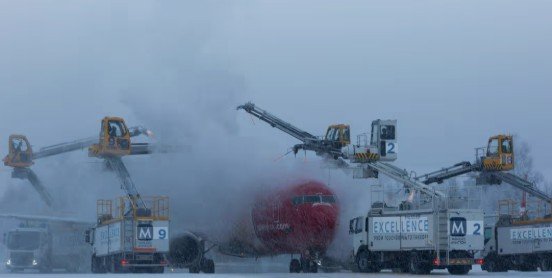
De-icing before take-off
It depended on the type of precipitation. If it were light snow, it’d be fine usually. Heavy snow, not so much. Freezing rain was a no go at all generally. Not only can icing change the aerodynamic profile of the wing, but it also adds a considerable amount of weight to the aircraft. It can also lock up flight controls.
After some weeks, the airport taxiways would end up with a layer of compressed ice on them, so taxiing became a skill. It needed to be slow and although we were never taught this, using asymmetric thrust to coax the aircraft around corners was very useful. We weren’t allowed to park the brakes on the runway, which you might do on a clean runway if there was a take-off delay. The reason for this was that a Korean Airlines 747 had attempted to take off with the brakes on a couple of years earlier. They put on take-off thrust, which was enough to get the bird skidding off down the icy runway. About halfway down, all the tyres burst, and the aircraft just managed to stop before the end of the runway.
As you can imagine, Anchorage airport was well set up for ice and snow, but sometimes there was so much of it that they couldn’t keep up, so they would work on keeping one runway open. Sometimes even that was a big job. I took off there one time with the left-hand runway lights under snow and only the right ones visible.
By the end of the winter, there would be huge piles of snow along the sides of the runways and taxiways. Landing in these conditions was interesting as well. The ATIS (aerodrome weather report) would give a braking action report starting at normal and reducing to poor. This was generally obtained from pilot reports. Braking action of poor or worse usually meant a diversion. On one landing I did there, the braking at the touchdown point was ok, but in the second half of the runway, it became apparent that there was zero braking happening, and I had to use reverse thrust all the way to taxi speed.
Fog in the winter was a double drama due to reduced visibility and icing. Freezing fog is a type of fog that forms in temperatures below zero degrees celsius. The tiny water droplets in the air remain as liquid. They become supercooled water droplets, remaining liquid down to temperatures as low as minus 10c. This occurs because liquid needs a surface to freeze upon……such as an aircraft wing. Temperatures below minus 10c are cause for celebration in fog.
Spring in Anchorage was probably my least favourite season because although the light increased, the thaw started, and everything became dirty and slushy. The melting snow combined with mud was everywhere. It wasn’t easy to keep anything clean. On top of this, cross country skiing was marginal. The spring skiing at Alyeska was fantastic, though, so we got into that with great enthusiasm.
Apart from mountain biking, the summer was full of other activities like fishing, white water rafting and hiking. My mother came up to visit during the second summer. We went for a hike down Kenai way for the day. At one point, we came around a corner, and there were two black bears on the path. We all said, “Farrrk. Bears!” And the bears said, “Farrrk. Humans.” And we went in opposite directions.
The flying continued through summer at a good pace. I was due for another line check to Tokyo with a Japanese checker. The weather wasn’t too bad when we took off, and it seemed like the flight would be pretty straightforward. Shortly after takeoff, the checker disappeared into the bunks.
About three hours into the flight, we got a call saying that a volcano had erupted on the Kamchatka Peninsula and that we would need to divert 500km south to avoid the ash. The first officer and I determined that we could just afford to do this and still make Tokyo, so we diverted to the south. At the end of the diversion, we turned towards the west and found that the headwind was half as strong again as forecast. Then, thirty minutes later, the weather in Tokyo deteriorated to the point where we needed an alternate airport. Suddenly we were looking like arriving in Tokyo with minimum fuel, in bad weather and with no fuel for an alternate.
Because of the direction we were coming from, Tokyo was now the closest suitable airport, so there was no inflight diversion capability. About an hour and a half out of Tokyo, the checker and woke and had a snack and a coffee, then joined us upfront. “Everything good?” he asked. I filled him in on the situation, expecting the checker to panic and suggest a ditching or something, but he just laughed and said, “Haha. You’ve really got your work cut out for you now.” In the end, we made it with minimum fuel.
In March 1994, JAL announced that they would have a foreign pilot basing in Honolulu. They wanted some of us to relocate there. The offer was quite generous because most people had bought a property in Anchorage and were not keen on moving. The other issue was that schooling in Hawaii was known to be difficult for teens if they are not locals. Bullying was rife. JAL was offering us full relocation expenses and a USD $10,000 bonus to move. I jumped at it. I’m not a cold-weather person, so Honolulu sounded pretty attractive.
I finished Anchorage flying on the 11th of May 1994.
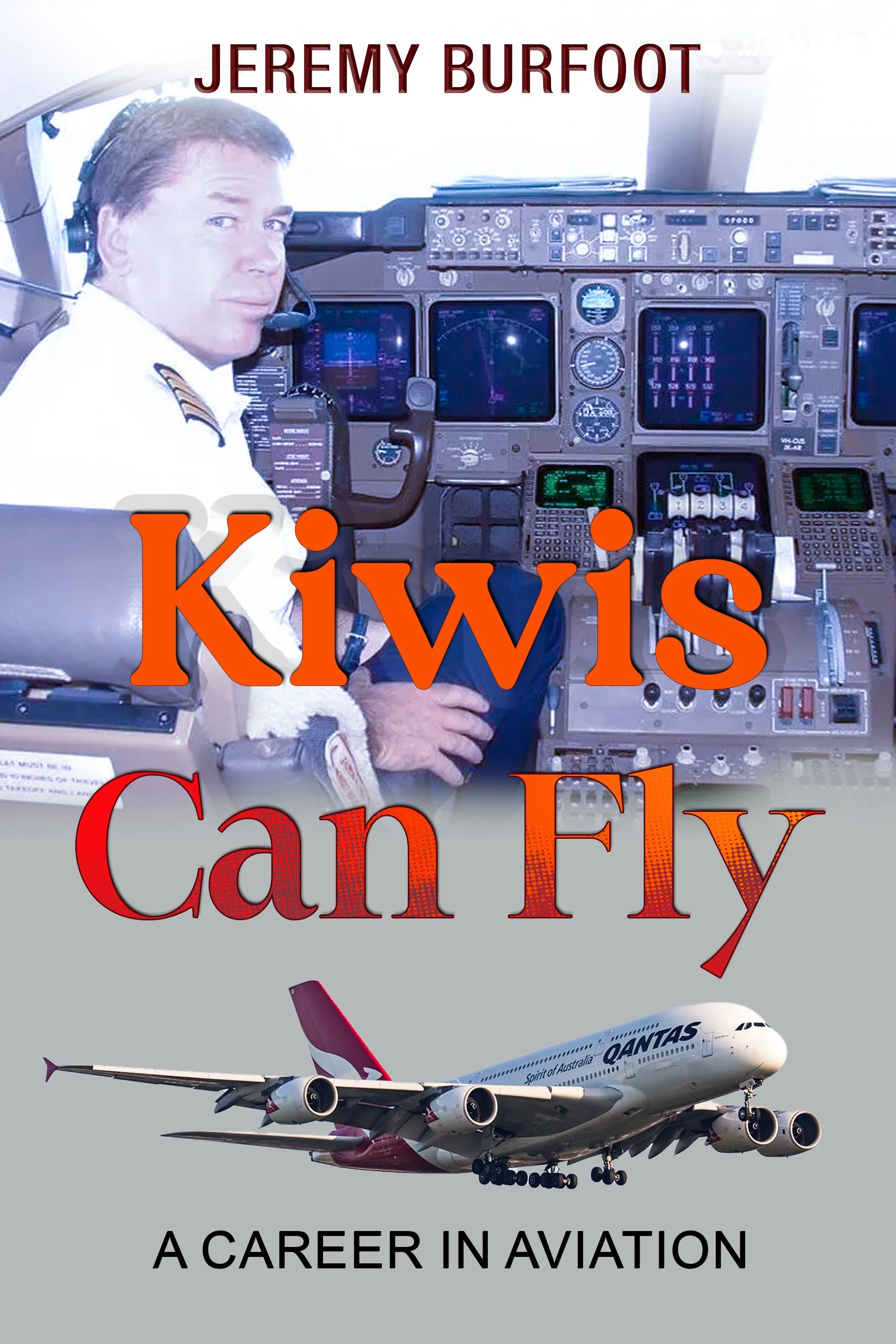
This article was an attempt at paraphrasing the appropriate part of Jeremy’s book “Kiwis Can Fly” - naturally with Jeremy’s blessing. The book is a great read - it’s the only time I’ve heard John laugh out loud whilst reading - I had to paraphrase to keep it decent for our varied readership! If you’d love to read more stories written in a kiwi bloke’s style, then get the book. If you’d like a copy you can go to Jeremy’s website - https://jeremyburfoot.com/ - and order a copy.